Arcana in 30 seconds
What Arcana does and where to find your cards
Arcana is a separate part of character progression. Cards occupy dedicated slots, raise skill levels, provide an Empyrean Lord stat and can activate a set effect. Their value is therefore broader than Item Level: two cards of the same rarity can do very different things for your character.
Open Arcana from the character menu. Check empty slots and the cards you already own. Read the rarity, enhancement level, main stat and skill effects together. The skill list is what tells you whether a card belongs in your current build, an alternative build or your supply of materials.

A usable item that grants a card is not the same record as the card itself. For example, Arcana: Chalice of Vigor (Bound) describes what you receive when used. Its catalogue Item Level is not the base Item Level of the resulting Arcana card. Compare finished cards in Arcana rather than judging them solely by the granting item.
Your first inspection
- Fill empty slotsFind a usable card for each available slot before comparing several options for one slot.
- Read the skillsLook for effects supporting your actual damage rotation, healing or survival tools.
- Check the setSee whether replacing the card changes an active set threshold, and read the condition attached to it.
- Keep an alternativeSave a card for another mode until you have compared the builds. Extract it only after that decision.
Chalice, Parchment, Compass, Bell and Mirror
A slot and a family answer different questions. Chalice tells you where the card goes; Vigor tells you which family it belongs to. Chalice of Vigor and Chalice of Magic compete for the same slot. Parchment of Vigor and Chalice of Vigor can contribute to the same set in different slots.
| Slot | Skill pool to check | Practical choice |
|---|---|---|
| Chalice | Active and passive skills for the class | Check the desired skill first; its broad pool makes an uncontrolled result less predictable |
| Parchment | One group of active skills | Read the actual list rather than assuming every active skill can appear |
| Compass | A different group of active skills | Compare its pool with Parchment before choosing a farming target |
| Bell | One group of passive skills | Check whether the passive works in your mode and build |
| Mirror | A different group of passive skills | Do not replace a valuable passive merely to finish a set |
Parchment and Compass have their own random skill groups, as do Bell and Mirror. “Farm any cards until the skill appears” is therefore an incomplete plan. Inspect the possible effects for the relevant slot, then choose a dungeon or a card to create.
Vigor and Magic also provide different main stats. Do not turn a main stat into a promised damage percentage without checking the character's other values. Compare the result in your character window and against the job the card needs to do.
| Slot | Vigor main stat | Magic main stat |
|---|---|---|
| Chalice | Time [Siel] | Space [Israphel] |
| Parchment | Life [Yustiel] | Destiny [Marchutan] |
| Compass | Freedom [Vaizel] | Death [Triniel] |
| Bell | Justice [Nezekan] | Destruction [Zikel] |
| Mirror | Illusion [Kaisinel] | Wisdom [Lumiel] |
Rarity, Item Level and enhancement limits
Item Level and skill level are separate values. One helps meet content requirements; the other changes a particular skill. A skill level and an Item Level point are not interchangeable rewards, even if both are useful.
| Card rarity | Base Item Level | Enhancement limit | Item Level at the limit |
|---|---|---|---|
| Common | 20 | +2 | 22 |
| Rare | 40 | +3 | 43 |
| Legendary | 60 | +4 | 64 |
| Unique | 80 | +5 | 85 |
Each card enhancement level adds 1 Item Level. That does not guarantee another level in the particular skill you want. Skill effects follow their own rules, so inspect the possible outcome before committing materials.
A Common card with a relevant effect can be a sensible temporary answer to an empty slot. That does not mean every temporary card deserves all your materials. Decide how long you expect to use it and what the next enhancement could actually improve.
Examples of Arcana granting items
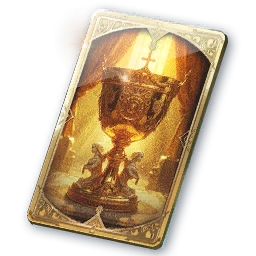 Arcana: Chalice of Vigor (Bound)UniqueUnique Chalice of Vigor: Time is its main stat; skill effects are determined when the card is obtained.
 Arcana: Parchment of Vigor (Bound)UniqueUnique Parchment of Vigor: active skill effects for its own slot.
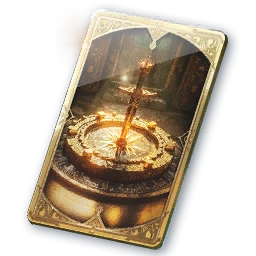 Arcana: Compass of Vigor (Bound)UniqueUnique Compass of Vigor: inspect its separate active skill pool.
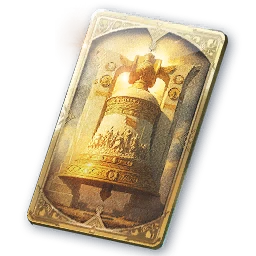 Arcana: Bell of Vigor (Bound)UniqueUnique Bell of Vigor: passive skill effects.
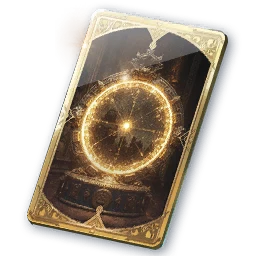 Arcana: Mirror of Vigor (Bound)UniqueUnique Mirror of Vigor: a different group of passive skills.
Where to get cards: choose the reward before entering
The main route is Transcendence. Start by identifying a weak slot rather than collecting an abstract list of every card. Check the dungeon reward list, prepare for its mechanics and make each attempt serve a specific purpose.
| Dungeon | Card families in its rewards | When to choose it |
|---|---|---|
| Deus | Bell, Compass, Chalice | You need that active pool, Bell passives or a Chalice |
| Arcanis | Mirror, Parchment, Chalice | You need Parchment actives, Mirror passives or a Chalice |
Difficulty affects the available rewards, but there is no guaranteed “Unique card in a few runs” here. Drop percentages from another regional version are not a reliable Global budget. Read the selected mode's reward list, entry requirements and resource use in the game.
If your group cannot clear consistently, work on the encounter first. Losing attempts while chasing an uncertain reward can be less useful than improving through quests and Daevanion. The Deus and Arcanis mechanics guides linked below cover the fights separately.
A card that misses your current build is not necessarily wasted. It may support another mode, provide enhancement experience or be extracted. Those uses compete: once the card has been consumed, you cannot reconsider it as an equipment alternative.
How to evaluate random skills
Judge a card by skills you actually use. Open the skill catalogue, check the names and compare the candidate with your equipped card. Include levels already supplied by Daevanion: the same extra level can have different value in different builds.
| Check | A useful result | A reason to pause |
|---|---|---|
| Main skill | Supports an action used regularly | Most effects belong to skills outside your rotation |
| Passives | Their conditions fit the selected content | They only help in a mode you are not playing |
| Replacement cost | Important effects remain available | Higher Item Level hides the loss of a key skill |
| Set | Its condition fits your encounters | The effect is inactive when you need it |
| Future enhancement | You understand the possible outcomes | You are assuming one chosen line must improve |
Distinguish the number of lines, total skill levels and the level of one effect. The enhancement data lists a cap of 4 for an individual selected skill effect. It does not promise that every newly obtained card grants four levels to one chosen skill. Read the resulting card after obtaining it.
A Chalice can be an appealing controlled craft when the desired effect is in its broad pool. This is a spending principle, not a compulsory first craft for every class. If your Chalice is already good and Parchment is empty, solve the actual gap first.
Enhancing Arcana: experience and materials
Enhancement uses experience and Kinah. Unwanted cards and Training Arcana can supply experience. Before confirming, check the target, every card being consumed and the expected level. Similar names can conceal a card from a different family or a useful alternative build.
| Training material | Experience in the description |
|---|---|
| Lesser Training Arcana | 200 |
| Intermediate Training Arcana | 600 |
| Superior Training Arcana | 1,500 |
| Ultimate Training Arcana | 3,000 |
| Exalted Training Arcana | 5,000 |
Training materials
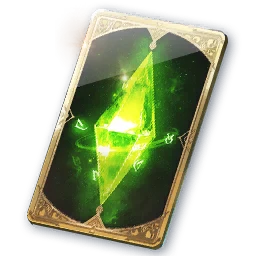 Lesser Training Arcana (Bound)CommonA small experience amount, useful when a card is close to its next threshold.
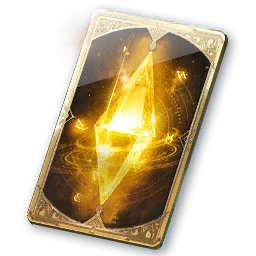 Superior Training Arcana (Bound)CommonA larger experience material; check the selected target first.
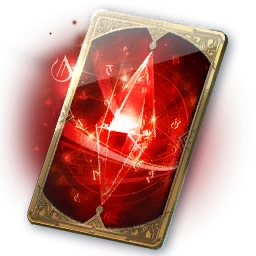 Exalted Training Arcana (Bound)CommonThe largest experience amount among the training items listed here.
Experience requirements differ by rarity and current card level. Check the remaining amount to the next enhancement rather than only the size of your stockpile. A large material may be more useful on another card if the current target needs very little.
Do not assume all invested experience will transfer unchanged when an enhanced card is later consumed. Inspect the actual preview instead of budgeting around a full refund that has not been verified.
Extraction and creating a card with selected skills
Mysterious Crystal is a card creation material. Its description explicitly connects it to Arcana extraction. Decide whether a card is truly surplus before extracting it: damage cards are not the only alternatives worth keeping.
Creation materials
 Mysterious Crystal (Bound)SpecialUsed to create Arcana; obtained through extraction.
 Shard: Mysterious Crystal (Bound)CommonA shard used in Substance Morph to obtain a Mysterious Crystal.
| Unique card creation | Mysterious Crystals | Kinah | What you control |
|---|---|---|---|
| One selected skill | 5 | 2,000,000 | One chosen skill effect |
| An additional selected skill | 15 | 5,000,000 | Two chosen skill effects |
These are the total costs, not an extra payment on top of the second row. The additional selection adds 10 crystals and 3 million Kinah to the base option. A selected skill still has to belong to the slot's allowed pool; creation does not place any skill on any card.
Before creating a card
- Choose the slotIdentify a real weakness in the current set of cards.
- Choose the familyCompare the Vigor or Magic main stat and set effect.
- Select the skillConfirm the effect is available, then consider the additional selection cost.
- Review the resultCompare it with your equipped card and keep Kinah for the rest of your progression.
Creation reduces uncertainty in the skill list. It does not make every remaining property ideal in advance. Spending everything for a Unique label can be a poor trade if it removes a useful effect or stalls other important upgrades.
Sets: Primal Vigor and Magic Armor
Vigor cards belong to Primal Vigor, while Magic cards belong to Magic Armor. The Russian client uses different wording for the Vigor set label and its triggered effect; the English client uses Primal Vigor for both. The underlying relationship is the same.
| Set | Pieces | Client effect | Condition |
|---|---|---|---|
| Primal Vigor | 2 | +60 PvE Attack | HP is at least 70% |
| Primal Vigor | 4 | +150 PvE Attack | HP is at least 70% |
| Magic Armor | 2 | Restores 1,500 MP | MP is 20% or less; 30-second cooldown |
| Magic Armor | 4 | +1,000 PvE Defense | MP is at least 50% |
Do not add these rows into your own combined bonus without checking active effects in the game. They describe separate client entries and activation thresholds. For equipment decisions, knowing whether the condition is met matters more than an attractive paper total.
If you frequently fall below the HP condition, the Vigor attack effect can be inconsistent. If your MP usually stays high, the low-MP restoration is not a constant resource gain. Neither observation makes a set bad; it means you should judge it against the encounter you actually play.
Choosing cards for your role
Damage: begin with your main attacks and useful passives, then compare main stats and set thresholds. Do not sacrifice an important skill level simply to complete a set unless you understand what that trade buys.
Tanking: consider survival and the skills that keep the encounter controlled. A defensive alternative may be more valuable during progression. Once the group clears reliably, compare offensive options again.
Healing: prioritise the tools you actually use to heal and support the group. Evaluate mana effects against real resource shortages. A restoration set cannot compensate for poor skill choices if its condition rarely activates.
Keep purposeful alternatives until you have tested a role change. A card that is unnecessary in routine farming can solve a problem on a difficult boss. You do not need to keep everything: preserve cards with a clear job and consume confirmed duplicates.
Do
- Compare cards within the same slot by useful skills and set conditions.
- Check Transcendence rewards before choosing a dungeon.
- Create a card when you know which effect you need.
- Read enhancement and extraction previews before spending.
Avoid
- Do not import drop percentages from another regional version.
- Do not confuse the granting item's Item Level with the finished card.
- Do not consume an alternative build with ordinary duplicates.
- Do not trade away a key skill for set completion without comparing the result.
Common mistakes
- Judging rarity aloneHigher Item Level can hide the loss of useful skill effects.
- Mixing up active card poolsThe desired skill is being hunted in the wrong slot.
- Treating a set as permanentIts HP or MP condition is not met during the important moment.
- Extracting immediatelyA card needed for another mode has already been consumed.
- Misreading creation costsTwo selected skills cost 15 crystals and 5 million Kinah in total.
Before spending materials
- Slot, family and rarity are confirmed.
- Useful skills are compared with the current build and Daevanion.
- You know which effects the old card will lose.
- Set conditions suit the selected content.
- The material list contains no useful alternatives.
- Creation or enhancement costs have been read before confirmation.
The essentials
Start with useful skills in every slot, then improve rarity and set effects. Deus and Arcanis supply different card families, while creation lets you select important skill effects. Separate genuine duplicates from cards with another purpose before extracting or enhancing. A worthwhile Arcana upgrade preserves the skills your build needs and solves a specific problem.
Comments